
Why Most AI Adoption Strategies Miss the Mark (And One Simple Test That Reveals If Yours Will Too)
Companies are throwing money at AI implementation right now. New tools every quarter. Training programs. Change management consultants. Integration specialists. Millions of dollars invested.
And a lot of it isn't working.
There's a quick test you can run with your implementation team — takes maybe five minutes — that'll show you if your AI strategy is built on solid ground or pure guesswork. More on that in a minute. But first, you need to understand why so many of these strategies are failing.
Not because the technology is bad. Not because employees are resistant to change or scared of losing their jobs. It's failing because companies are implementing solutions to problems their employees don't actually have.
Here's what we keep seeing: A company decides they need AI to improve productivity. They roll out tools designed to save time and automate routine tasks. Six months later, adoption is sluggish, people are finding workarounds to avoid the new systems, and leadership is confused about why their "human-centric" approach didn't land.
Then we profile the workforce and find out productivity wasn't the issue. These employees cared most about shared values like Creativity and Personal Growth. They didn't want to save time on routine tasks; they wanted more chances to do challenging, original work. The AI strategy solved a problem that didn't exist while ignoring what people actually cared about.
You Can't Build Human-Centric Anything Without Knowing Your Humans
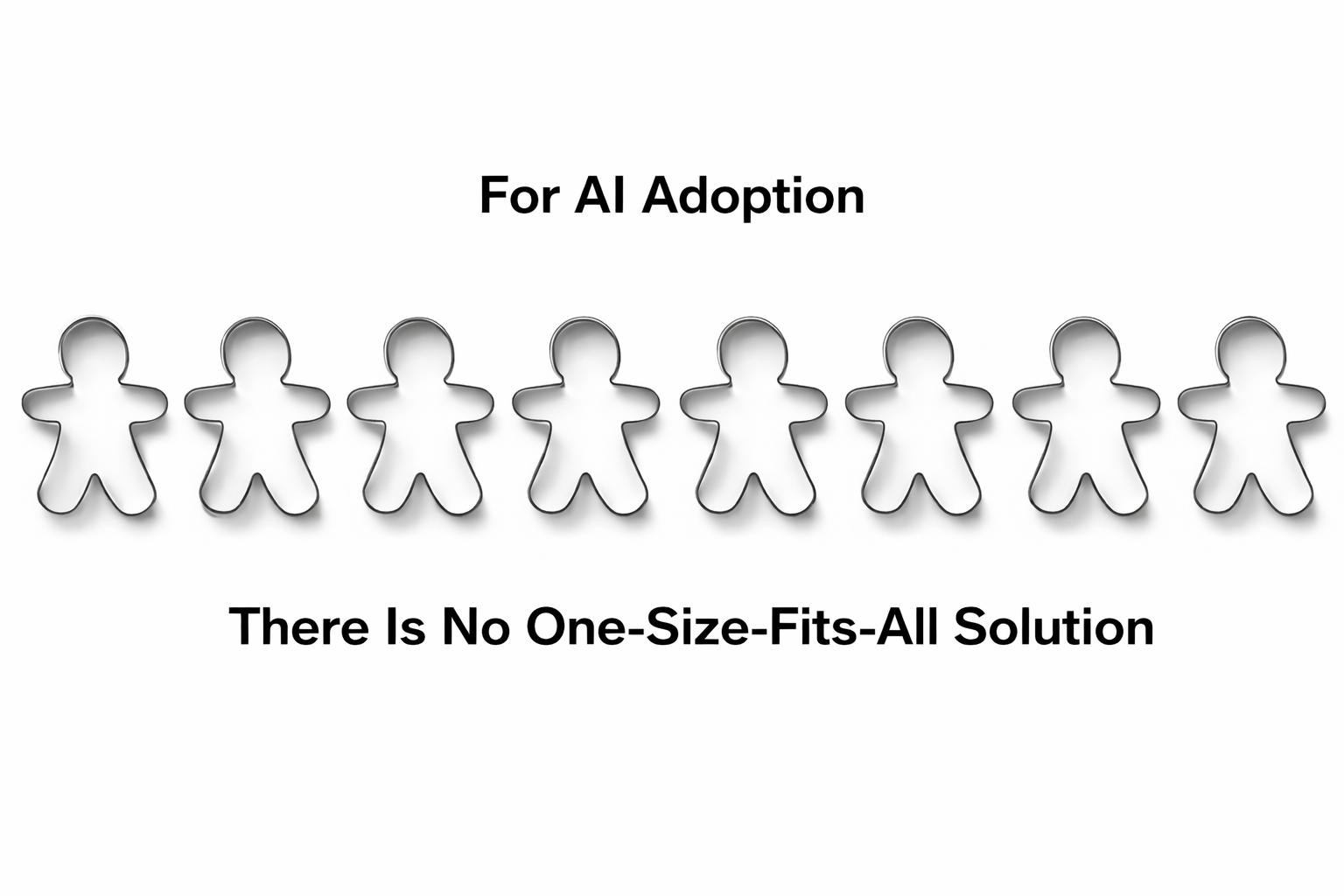
There's this assumption baked into most AI implementation strategies: people are people, and what works at one company will work at another. Just copy best practices. Follow the playbook. Do what the successful companies did.
But workforce A and workforce B are not the same group of people. They don't care about the same things. What motivates engineers at a tech startup is completely different from what motivates nurses at a hospital system. Even two hospitals in different cities will have workforces with different values-profiles.
We profiled two retail organizations last year, both in the same industry, similar size, and similar geographic footprint. One workforce cared most about Financial Security and Employment Security. The other cared most about Community and Relationships. If both companies had implemented a generic "best practice" AI strategy, both of them would have gotten it exactly wrong.
The Data Tells You What Your Gut Can't
When you measure what matters most to your specific workforce, you stop guessing. You find out which of the 56 statistically verified Valuegraphics values drive your people. Then you can design AI implementation around those values instead of around assumptions.
If your employees value Belonging and Community, you know AI tools that isolate people or reduce face-to-face interaction are going to face resistance. You need to prioritize solutions that enhance collaboration and strengthen workplace relationships.
If your workforce values Independence and Self-Expression, the exact opposite might be true. Those employees might embrace AI tools that give them more autonomy and free them from collaborative bottlenecks.
Same technology options. Opposite human-centric strategies. Because humans are different.
A Simple Test You Can Run Right Now
Here's that test. You can do this today to see if your AI strategy has a values problem.
Pull together your AI implementation team. Ask them to individually write down the top three things they believe employees care most about when it comes to work — not about AI adoption, just about work in general. What matters most to people about showing up and doing their jobs? Don't let the team collaborate or discuss. Just have everyone write their answers.
The reason you're asking about work in general is simple: people don't care about different things depending on the topic. They care about what they care about. Someone who values Creativity at work values Creativity everywhere. Someone who values Financial Security isn't going to suddenly care about Community just because you're implementing new technology. Values don't change based on the subject. They're consistent.
Now compare the lists.
If you see wildly different answers, that's your first problem. Your leadership team doesn't even agree on what motivates your workforce. You're building a strategy on conflicting assumptions.
But here's the more important question: how would you know if any of those answers are actually right?
You wouldn't, not without measuring.
This exercise doesn't give you the answer, but it shows you how much you're guessing. And once you see the guesswork clearly, you can decide whether you want to keep building million-dollar strategies on top of it.
This Changes Every Decision You Make
Which departments get AI tools first? That depends on values. How do you train people to use new systems? That depends on values. Whether you automate a particular job function or keep it human? That depends on values.
These aren't messaging decisions. These are fundamental strategy decisions that determine whether your AI investment actually delivers value or creates expensive friction.
We've Done This a Million Times
The Valuegraphics Research Company maintains the world's largest database of human values research. We've surveyed a million people across 180 countries in 152 languages about what matters most to them, and we use what we learned to measure what matters most to your workforce.
When you bring us in to profile your employees, you get a clear picture of the values that drive your organization. Not generic insights about "millennials" or "remote workers." Actual data about the specific humans who work for you.
Then you can build your AI strategy around that data. You can make decisions that align with what your people actually care about. You can implement technology in ways that feel like it's designed for them, not borrowed from someone else's playbook.
Stop Guessing. Start Measuring.
Human-centric AI isn't a buzzword when you actually know which humans you're building for. It's a competitive advantage.
Ready to find out what your workforce actually values? That's all we do. Let's talk.